I Want the Training
Biblical Counseling Training ? what to do when someone comes to you in crisis

Someone will fall apart in front of you this week. You have five minutes not to make it worse ? and no one has ever taught you what to do

This is not a course to turn you into a counselor. It is spiritual first aid for the person others seek out without asking for it: what to do in the first five minutes, what to say, what never to say, how to apply the Word without wounding ? and how to recognize, without hesitation, when it is time to call someone who is. For the leader who is not a psychologist, therapist, or pastor. And who, even so, is the person they came to.

I Want to Know What to Do in the Next Conversation

Immediate access ? One-time payment of $7.90 ? 30-day guarantee
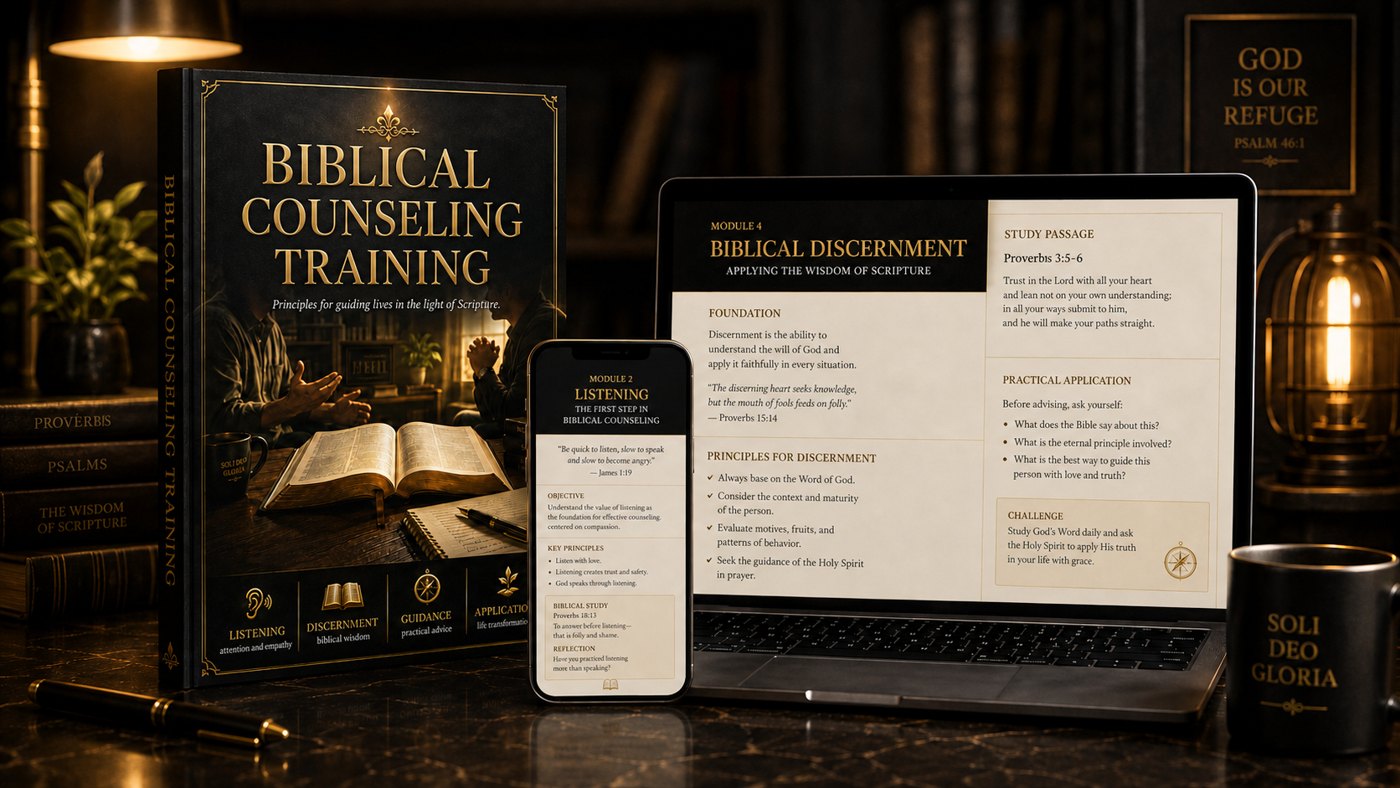
The training on screen and in print
12 Modules + 8 Bonuses

12

Training modules, from the first minute of the conversation to caring for the caregiver

8

Included bonuses ? 7 pocket tools + the Super Bonus with 12 worked cases

12

Difficult situations unpacked step by step in the Super Bonus ? from grief to doubts of faith

5

Steps of a caring conversation: Listen, Discern, Apply, Follow Up, and Refer

What you will know how to do after reading ? and what will still not be your role

See what is inside the training

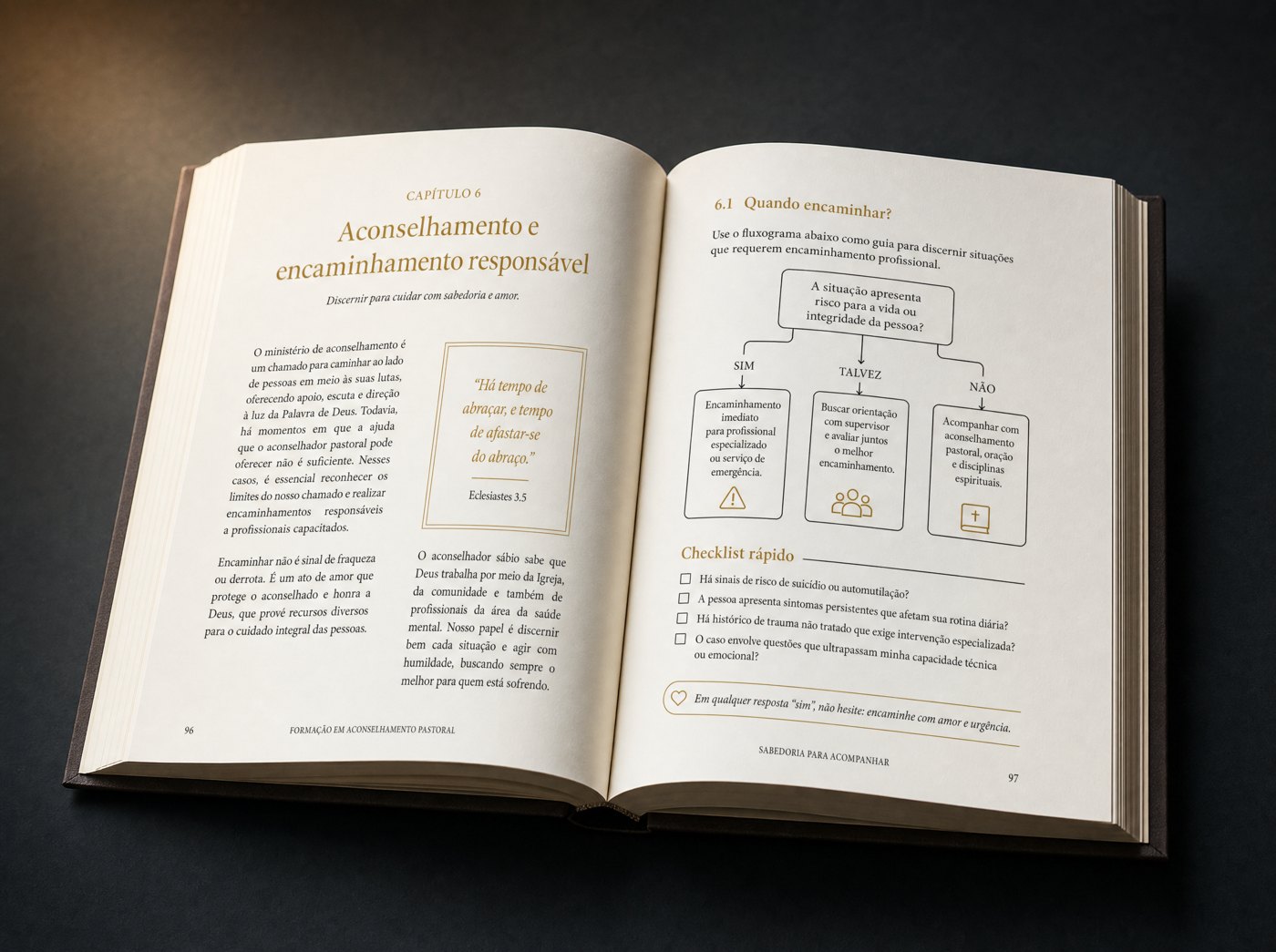
Inside pages: when to refer

The first five minutes

What to do with your hands, your eyes, and your phone. The question that invites without intruding. Why almost all the damage happens because someone spoke too soon.

What never to say ? and what to say instead

"Everything will be okay," "God has a purpose in this," "it could be worse." Why each one wounds, and the exact phrase that welcomes in its place.

When the person falls apart and you have nothing to say

How to sit with a long pause without filling it. Why having nothing to say is often, precisely, the right response.

The signs that change everything

Abrupt change, growing isolation, veiled goodbyes, persistent hopelessness. In plain language, without clinical jargon or labeling anything.

The time to call someone who is

The six matters no lay leader can handle alone, what to do in the first 24 hours of a serious case, and how to refer without abandoning the person.

Sample excerpt ? Module 3

"Everything will be okay."

Why it wounds: it is a promise you do not have the authority to make. You do not know whether everything will be okay ? no one does. And if things do not turn out well later, the person will remember that you promised something that did not come true, which erodes their trust in you and, by unfair association, in God.

What to say instead: "I do not know how this will end. But I know you will not face it alone."

And the quick test for any new phrase that comes to your lips: does this phrase exist to comfort the person, or to ease my own discomfort with silence?

"Wherefore, my beloved brethren, let every man be swift to hear, slow to speak, slow to wrath:"

James 1:19

No one chooses to be sought out. You were chosen because someone trusts you, not because of your training

The message that arrives at 11 PM
01

The 11 p.m. message

Your phone lights up in the dark. It is someone from your group. "Do you have a minute?" Then, in three paragraphs, comes something you never imagined that person was carrying. You read it twice. You type a reply. Delete it. Type another. Delete it again. You stare at the "typing..." no one can see, knowing the silence has already lasted too long ? and that anything you send now could help or hurt, and you have no idea which it will be.

02

"Can I talk to you?"

The meeting is over, everyone has left, and one person stayed behind. They ask for "just a minute" ? and the minute becomes a revelation too heavy to bear: a betrayal, a diagnosis, a child who says they no longer want to live. Your face grows hot. You know your reaction in the next three seconds will determine whether they keep talking or shut down forever. No one ever taught you what to do with your face in that moment.

03

The fear of saying the wrong thing

You have seen it happen. You said "God has a purpose in this" to someone in recent grief, with the best of intentions, and watched the person stiffen and change the subject. Ever since, you have been afraid to open your mouth. So you listen quietly, say little, and leave the conversation thinking you were a weak leader ? when in fact the problem was never courage. It was having no one to teach you what to put in its place.

04

The silence after they opened up

The person cried through the whole meeting, and you just stayed there. Then they left. And then came the part no one talks about: the next day. You do not know whether to send a message or intrude. You do not know whether to tell the pastor or betray their trust. You do not know whether it was serious or whether you are overreacting. And you carry it alone ? for weeks, sometimes months ? with no one to talk to, because the secret is theirs and the weight stayed with you.

The fear of making someone's situation worse is not weakness. It is the most responsible thing you could be feeling ? the person who is not afraid of getting it wrong here is precisely the one who makes the most mistakes. But fear alone does not teach anyone how to lead a conversation. What is missing is not faith, good intentions, or love for people: you have all three, and that is why people seek you out. What is missing is preparation ? and preparation can be learned. You will not become a psychologist by reading this. You will know exactly what to do in the part that is yours, and you will recognize without hesitation where it ends.

"He that answereth a matter before he heareth it, it is folly and shame unto him."

Proverbs 18:13

The training that begins where good intentions are no longer enough

The first five minutes Listening that welcomes What to say and what not to say Signs of severity Boundaries and referral Confidentiality Follow-up Care for the caregiver
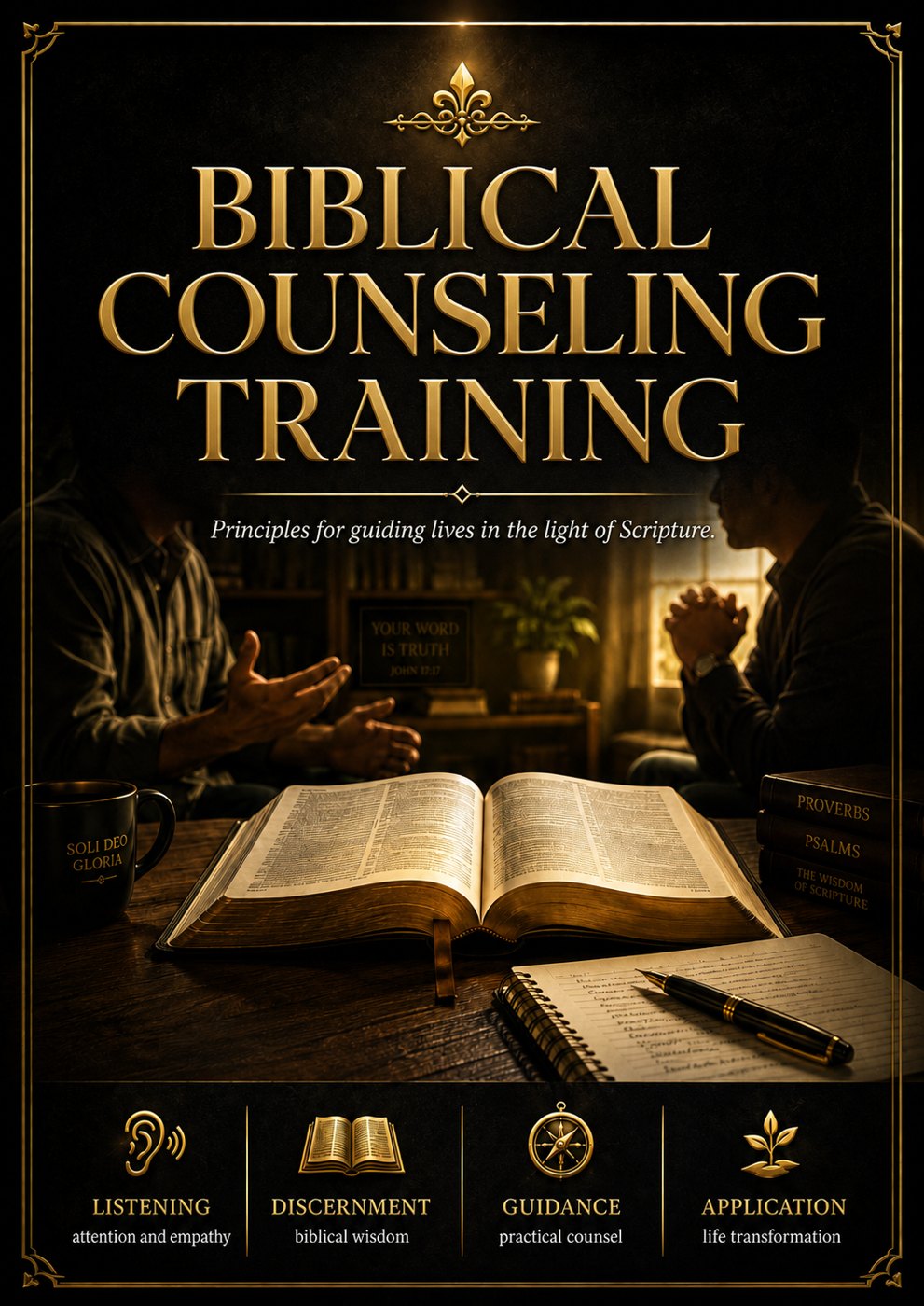
Cover of the Biblical Counseling Training

It is not counselor training. It is moment zero

Serious counseling programs take months or years, cost hundreds of dollars, and ask you to adopt a theological approach. This training competes somewhere else: the moment before any counseling school matters. It is not a career. It is next Wednesday night, when someone asks you for "a minute."

It teaches where your role ends

Most care material teaches what you can do. Here, an entire module ? the most important of all ? teaches what you should not try to do alone, which six situations require help beyond yours, and how to refer without abandoning anyone. Referring is not failure by the caregiver. It is the highest form of love when a case exceeds your capacity.

It does not enter the debate that divides the field

Sincere Christians who are faithful to Scripture differ over the exact role of psychology in the care of souls. This training does not enter that debate or take sides in it. It exists for the moment before any debate matters: someone is in front of you now, and you need to know how to listen, respond with biblical wisdom, and recognize when it is time to call for help. Interdenominational evangelical doctrine, from beginning to end.

12 modules: from the first minute of the conversation to care for the caregiver

The counselor's material ready on the desk
01 Foundation

Why people come to you (and why that does not require a degree)

  • The role of the first responder: presence, listening, prayer, wisdom, and boundaries ? not therapy, not a verdict
  • Why accessibility, not credentials, is what makes someone chosen to listen
  • The shift that disarms fear: from "I need to have the answer" to "I need to lead the first few minutes well"
02Listen

The art of listening before responding

  • The difference between truly listening and merely waiting for your turn to speak
  • The five habits that destroy listening ? including two that look like kindness
  • What to do with your hands, your eyes, and your phone while the person speaks
03Listen

The first words: what to say and what never to say

  • The well-intentioned phrases that wound, one by one, with the exact alternative for each
  • How to respond to a shocking disclosure without letting your face show judgment
  • Job's friends: they get it right in silence and go wrong when they begin explaining suffering
04Listen

Tears, silence, and raw emotion

  • What to do when the person falls apart and you have nothing to say
  • How to sit with a long pause without filling it with advice
  • Wisdom in one-on-one conversations: with whom, where, with which door open ? protection for both sides
05Discern

Recognizing severity: what is different from ordinary sadness

  • Warning signs in plain language ? without clinical jargon or labeling anything
  • The layperson's golden rule: when in doubt about severity, treat it as serious and involve someone who knows more
  • What this module explicitly does not do: diagnose, label, or pronounce judgment
06 Discern
Required module ? the heart of the training

Ethical boundaries and the time to refer

  • The six matters that are never handled alone ? and how to recognize each sign
  • How to stabilize the conversation with safety and presence while the right help has not arrived
  • How to refer without abandoning: the difference between "this is not my problem" and "I will go with you to someone who can help"
  • How to build your local list of resources and emergency phone numbers before you need it
"No other lay-care material delivers this line with this clarity. It is the module that protects the person who opened up to you ? and protects you."
07Discern

Confidentiality with wisdom: what to keep, what to tell

  • The standard you have never had: what stays between the two of you, what goes to leadership, and what requires outside help
  • What to say at the beginning of a conversation so you do not promise what you cannot keep
  • Why carrying a serious secret alone harms you and protects no one
08Apply the Word

Scripture with wisdom: neither a weapon nor a bandage

  • Why the right verse at the wrong time makes a person shut down
  • When Scripture comforts, when it guides, when it confronts ? and why confrontation almost never belongs in a first conversation
  • The place of biblical lament: the Word has language for pain, not only for solutions
09Apply the Word

Praying with someone who is suffering

  • How to pray without turning prayer into an indirect sermon or a promise of an outcome
  • What to ask for and what never to affirm in prayer before someone in pain
  • What to do when the person says they do not want to pray
10Follow Up

After the conversation: the next 48 hours and the weeks that follow

  • How to end a difficult conversation well and what to agree on before you part
  • The next-day message that changes everything ? and what to do when the person does not return
  • How not to become someone's only source of support: caregiver dependence is harm, not success
11Follow Up

Working together with the pastor and leadership

  • When to involve them, how to involve them, and how to speak about a case without unnecessarily betraying trust
  • How to have that conversation when you fear the reaction
  • What to do if your church has no care structure ? without confronting anyone
12Breathing Room

Caring for the caregiver

  • Signs of caregiver exhaustion: irritability, insomnia, avoiding messages, emotional numbness, guilt
  • Bearing your brother's burden without taking on the load only he can carry
  • Guilt-free time boundaries, who to process with ? and when you are the one who needs to seek help

The 12 modules are complemented by an introduction, conclusion, and narrative summary.

"Rejoice with them that do rejoice, and weep with them that weep."

Romans 12:15

This training was written for you if...

People seek you out, even though you did not ask for it

Small-group leader, discipler, deacon, youth, women's, or couples' leader. People seek you out because they trust you and because you are close by ? not because you are trained. And it will happen again this week.

You have already had a conversation you did not know how to lead

You froze. You lost your footing. You said something that came out wrong, or said nothing and left feeling useless. That conversation still comes back to your mind ? and you want to be ready next time.

You are afraid of making someone's situation worse

That fear is why you should read this. It is not weakness: it is responsibility. What is missing is not courage; it is knowing where to step ? and where to stop.

You lead people and have never learned how to care for them in crisis

Associate pastor, supervisor, ministry leader: you learned to teach, organize, and lead. No one ever sat down with you to teach you what to do when a person falls apart.

This training is not for you if...

  • You are seeking certification, credentials, or professional counseling training. This material certifies no one, issues no diploma, and does not qualify you to practice as a counselor. Serious training institutions exist for that, with months of coursework and supervision ? and this product does not compete with them or pretend to.
  • You want a substitute for therapy, medical treatment, or psychiatric care. This is not that, under any circumstances. This training exists, among other things, to say exactly the opposite.
  • You want a treatise on which counseling school is right. We deliberately take no side in that debate.
  • You expect to learn how to solve someone else's crisis. No one can promise that. What this training gives you is knowing what to do, what to say, and when to call for help. The outcome of another person's life has never been in your hands.
  • You want academic theory. This is a practical manual for the conversation that may happen as soon as this week.
Testimonials

What people who use it in church care say

★★★★★

The module on referral lifted a weight I had carried for years: understanding that passing a case on is not failing the person. It changed how I listen.

AB
Rev. Alan Bennett
Columbus, OH
★★★★★

The first-five-minutes card stays in my wallet. It is not a memorized script ? it keeps me from saying the foolish thing I would say out of nervousness.

MS
Martha Sanders
Nashville, TN
★★★★★

I use it to train deacons. Before, each person responded in their own way, some with a verse taken out of context, others with folksy advice. Now there is a consistent way to care.

WA
Rev. William Adams
Phoenix, AZ
★★★★★

The chapter on warning signs led me to seek professional help for someone in my small group. I would not have recognized it on my own, and I would not have known how to speak about it.

JP
Julia Parker
Richmond, VA

Illustrative testimonials, representative of how the material is used.

TOTAL VALUE OF WHAT YOU RECEIVE

Everything included, added together:

If you pursued each piece separately, here is what you would pay:

Biblical Counseling Training ? 12 complete modules$29
Bonus 1 ? What Never to Say (and What to Say Instead)$9
Bonus 2 ? Pocket Card: the First Five Minutes$7
Bonus 3 ? Warning Signs in Plain Language$9
Bonus 4 ? Referral Checklist: the First 24 Hours$9
Bonus 5 ? How to Talk to Your Pastor About a Case$7
Bonus 6 ? Prayer Guide for Walking with Someone Who Is Suffering$7
Bonus 7 ? 7-Day Devotional for Caregivers$7
SUPER BONUS ? Difficult Situations Manual: 12 Cases, Step by Step$39
Lifetime updatesPriceless
Total Value$123
Take everything today for only
$7.90
You save $115.10 ? and the bonuses alone are worth almost twelve times what you pay: the entire training is free

Introductory promotional price. Subject to change.

Get My Access Now

Complete 12-module training ? from the first five minutes to care for the caregiver

7 pocket bonuses: phrases, 5-minute card, warning signs, referral checklist, pastor conversation guide, prayers, and caregiver devotional

Super Bonus "Difficult Situations Manual: 12 Cases" ? perceived value of $39

Immediate access after payment confirmation, as a PDF, on your phone

Lifetime updates ? every new case added, at no extra cost

Full 30-day guarantee ? no questions asked, no red tape

8 ready-made materials you receive with it, at no extra cost

None of them is "more content to read." They are tools to consult in thirty seconds, often on your way to the conversation. Together, they are worth $94: almost twelve times what you pay today.

Cover of the Super Bonus Handbook of Hard Cases
Super Bonus

Difficult Situations Manual: 12 Cases, Step by Step

Twelve real, anonymized situations, each with the method applied from beginning to end: recent grief ? discovered betrayal ? marriage in crisis ? persistent depression ? anxiety and panic crisis ? prodigal child ? serious doubt of faith ? job loss and shame ? serious diagnosis in the family ? substance dependence at home ? pregnancy loss ? loneliness in old age. For each case: what the person usually says, what to hear beneath it, what to say and what not to say, which passage fits, what to do in follow-up ? and the exact point where that case stops being yours and becomes a referral. No case ends with you resolving the crisis, because that is not what this material promises. This bonus alone would be worth the investment.

Perceived Value$39

What Never to Say ? and What to Say Instead

Fifty well-intentioned phrases that wound, each with a welcoming alternative: grief, illness, betrayal, depression, divorce, rebellious child.

Value: $9
Fits on your phone

Pocket Card: the First Five Minutes

One page only: how to open, three questions that invite without intruding, what to watch for, what to avoid. Open it on your phone on the way to the conversation.

Value: $7

Warning Signs in Plain Language

A quick-reference guide to the signs that change the nature of a conversation, and the corresponding action for each. No clinical jargon, no diagnosis.

Value: $9
Exclusive

Referral Checklist: the First 24 Hours

What to do, in order, when a case is serious: what to say, whom to contact, what to document, how to follow up. With room to build your local resource list.

Value: $9

How to Talk to Your Pastor About a Case

A guide for bringing a situation to leadership while preserving as much as possible the trust of the person who opened up: what to share, what to hold back, how to ask permission.

Value: $7

Prayer Guide for Walking with Someone Who Is Suffering

Prayer templates for acute crisis, grief, fear, guilt, and waiting ? and what never to affirm in prayer before someone in pain.

Value: $7

7-Day Devotional for Caregivers

One week of short readings to process the weight of what you hear: lay it down before God, examine boundaries, recover your breath.

Value: $7

+ Lifetime Updates

Every revision and every new case added to the material, forever, at no extra cost.

Value: Priceless
Introductory promotional price

Biblical Counseling Training

What to do when someone comes to you in crisis: listen well, respond with wisdom, and recognize when it is time to call someone who is ? even if you are not a psychologist, therapist, or pastor

  • 12 complete modules, from the first five minutes to care for the caregiver
  • Complete Module 6 on ethical boundaries and the exact time to refer
  • 7 pocket bonuses worth $55
  • Super Bonus: Difficult Situations Manual ? 12 cases, step by step ($39)
  • Immediate access via PDF download ? works on your phone
  • Lifetime updates, always the latest version
  • Full 30-day guarantee
From $123 for only
$7.90
One-time payment ? Lifetime access
I Want Access Now for $7.90
Secure purchase Instant access Secure payment

Full 30-Day Guarantee

Read the training and apply it in your next difficult conversation. If, within 30 days, you do not feel that you know how to listen better, respond more wisely, and clearly recognize when it is time to refer, we will refund 100% of your investment. Just send an email. No questions, no red tape.

We take all the risk.

"Where no counsel is, the people fall: but in the multitude of counsellors there is safety."
Proverbs 11:14

Still have questions?

Yes ? and this material was written for you. You will not become a psychologist, therapist, or certified counselor by reading this training, and it does not promise that in any line. What it does is prepare the trusted person who is already sought out: how to listen well, what to say, what never to say, how to apply the Word without wounding, and above all, how to recognize when it is time to call someone who is. People already seek you out, whether you want it or not. The question was never whether you would listen to someone in crisis ? it is whether you will know what to do when it happens again.

No. Under no circumstances. This material is spiritual care and brotherly support; it is not therapy, it is not diagnosis, and it does not replace medical, psychological, or psychiatric treatment, nor emergency services. In fact, much of the training exists to say the opposite: there are situations in which the most spiritual, most biblical, and most loving thing you can do is help someone reach a professional. Seeking medical or psychological help is not a lack of faith.

That fear is the No. 1 reason this training was written ? and having that fear is a sign of responsibility, not a lack of spiritual preparation. The person who is not afraid of getting it wrong here is precisely the one who makes the most mistakes. The whole training works on both fronts: what to do (so you do not wound through lack of preparation) and what not to is not try to do alone. Module 6 lists the six situations that require help beyond yours and teaches how to refer without abandoning the person. The goal was never for you to get everything right. It is for you not to make things worse through lack of preparation and not to carry alone what is not yours.

Neither one ? and that is a deliberate choice. Sincere Christians who are faithful to Scripture differ over the exact role of psychology and therapy in the care of souls, and that is a legitimate debate, with serious literature on both sides. This training does not enter that debate or take sides in it. It does not teach a counseling system: it teaches what to do when someone comes to you. Listening attentively, speaking wisely, applying the Word at the right time, and recognizing boundaries are biblical practices every evangelical tradition affirms ? they are not the banner of a school. The content is interdenominational evangelical Protestant from beginning to end.

No. There is no certificate, credential, diploma, or qualification of any kind ? and we prefer to say that here, plainly, rather than let you discover it after buying. If you are seeking professional counseling training, serious institutions exist for that, with months or years of coursework, guided reading, and supervision. This training is something else: preparation for the moment before any training matters ? when someone falls apart in front of you and the professional is not there.

It is ? and it remains so. This material does not replace pastoral authority; it exists to work alongside it. The reality is simple: people usually seek out whoever is closest first, not whoever holds the title. You are the first response, and the pastor is an essential part of what comes next. That is why there is an entire module (Module 11) on when to involve leadership, how to involve them, and how to speak about a case without unnecessarily betraying trust ? plus a bonus with a ready-made guide for that conversation.

It depends ? and that is exactly the standard Module 7 provides. Some things stay between the two of you, some need to reach pastoral leadership, and some require immediate outside help. Confidentiality is never absolute when there is risk of death or abuse, and the training teaches what to say at the beginning of a conversation so you do not promise what you cannot keep. Carrying a serious secret alone protects no one: it harms you and delays the help someone needs.

It is not a course, it has no video lessons, and it will not take your evenings. It is written to be read in parts, and some tools were made for precisely the opposite: the Pocket Card fits on one page and can be consulted in thirty seconds, on your phone, on the way to the conversation. You do not need to finish the entire training to use something from it this week.

Most material in the field is training: theory, schools, foundations. That has value, but it does not help when someone is crying in front of you and you have three seconds to react. Here, it is the opposite: exact phrases, what to do with silence, which signs change the nature of the conversation, what to do in the first 24 hours of a serious case, and 12 complete cases worked out step by step in the Super Bonus. Practice, not a system.

Immediately after payment confirmation, you will receive an email with the PDF download link. Access is instant and lifetime, opens on any computer, tablet, or phone, and continues to work offline after downloading. No special software or platform subscription is required.

They are optional add-ons ? such as the Training Workbook, the active listening guide, the guide for supporting someone in grief, and the first-care guide for an anxiety crisis. You receive the complete training with all 8 bonuses even if you add none of them. They are there only for those who want to go further.

You are covered by the Full 30-Day Guarantee. Just send an email, and we will refund 100% of your investment. No questions, no red tape. We take all the risk.

The next 11 p.m. message will come. The difference is you know what to reply

You do not need a degree, more faith than you already have, or to become a professional at anything. You need to know how to lead the first few minutes well, say what welcomes instead of what wounds, and recognize without hesitation when it is time to call someone who is. That is all this training promises ? and it is exactly what was missing. Prepare today, while no one needs you.

$123 $7.90
I Want Immediate Access for $7.90
Secure purchase Instant access 30-day guarantee Secure payment
$123 $7.90
I Want the Training